Wondering what gutta and silk painting is all about?
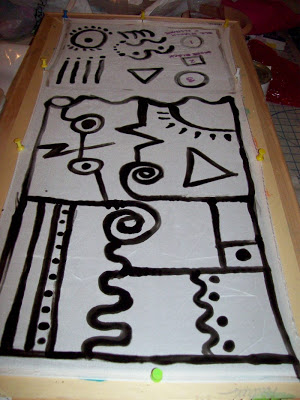 Many people ask me about GUTTA [pronounced ‘goo-tah’] and I tell them about what I learned as a new Silk Artist many moons ago.
In the 1980s I had just moved to Paris [France] to live with my boyfriend who was a silk artist.
I had never heard of this before, so for a couple of days I watched everything he did during the amazing process of stretching the silk onto home-made wooden frames with nails along the sides to stretch the silk onto.
Then I’d watch him place a hand-drawn design under the frame, so he could see the design through the silk, and he would outline or trace the design with a squeezy bottle of some magical substance. I later learnt this was a French glue-like substance called GUTTA.
This was all done with the ancient French Serti Technique.
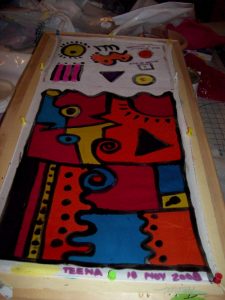 Those days really were magical, as I learnt to paint on silk and took to it like a pro from day one.
I didn’t question the processes or products, I just followed instructions.
The best bit was taking the metro to go visit the little old lady who had a corner store where she ‘set the colours’ on the silk, hemmed the silk piece and sewed a label in it. Way back then that process cost around one dollar for all that – amazing!
It wasn’t until I returned to Australia and had to find the products and steam-set the silk myself, that I learnt about the idiosyncracies of GUTTA and how hard it would be to find someone to steam-set my hand-painted silk.
GUTTA
Gutta is a glue-like thick substance that is made from latex ( derived from the Pallaquium tree in Indonesia.) It is used almost exclusively for the French Serti Technique of painting on silk [this is the technique I learnt in Paris].
Gutta can be used with all dyes. It can be applied using applicator bottle with metal nib, brush or sponge. The metal nibs come in different sizes.
Gutta comes in clear, black, gold, bronze and silver metallics. It has a rubbery feel in contrast to the smooth drape of the silk, and it has a turpenoid base which can only be successfully removed by dry cleaning after steaming.
Traditionally, ONLY the clear and one brand of black resist could be dry-cleaned. The others remain on the silk and can sometimes pull at the silk.
WATER BASED RESISTS
“A ‘resist’ is anything that prevents the dye from reaching fabric
or from bleeding with other dyes; it RESISTS the dye – it forms a ‘barrier'”
These are gutta-like but because they are not made with gutta [gum], they are called ‘resists’. Resists are water soluble and come out with warm water and a little elbow grease. The resists work just like gutta and can also be tinted with dyes. Some can be steamed, others get too gummy. Water soluble resists CANNOT be dipped into fixative baths. They turn gooey and hard to remove. You can use them together but you have to paint the fixative on. Water-based resist is what I moved onto after about 10 years of solvent-based gutta – it was easier to remove.
WAX
Wax is used primarily for batik and batik variations. The wax is melted and hot wax is applied to the fabric with a brush or a tool called a ‘tjanting’. I have tried wax as a ‘resist’ but to be honest it wasn’t my cup of tea – too messy and very time consuming, but I know many silk artists who love the wax application process which enables them to build up layers of colour which no other process can do in quite the same way.
Which one do I think is ‘best’? Well, it does depend on what you like – you need to try all the techniques and see what feels right for you. If you decide to go with the water-based resist, I can highly recommend the best one I’ve found [and I’ve tried a LOT over the years] – Procolour from New Zealand, invented by John Mitchell – now owned by Jacquard in the USA.
- Recommended book: The Artist’s Guide to Gutta and Wax Resist Techniques by Susan Louise Moyer